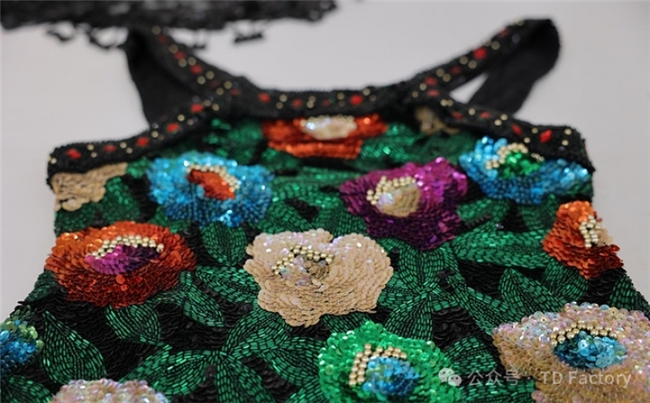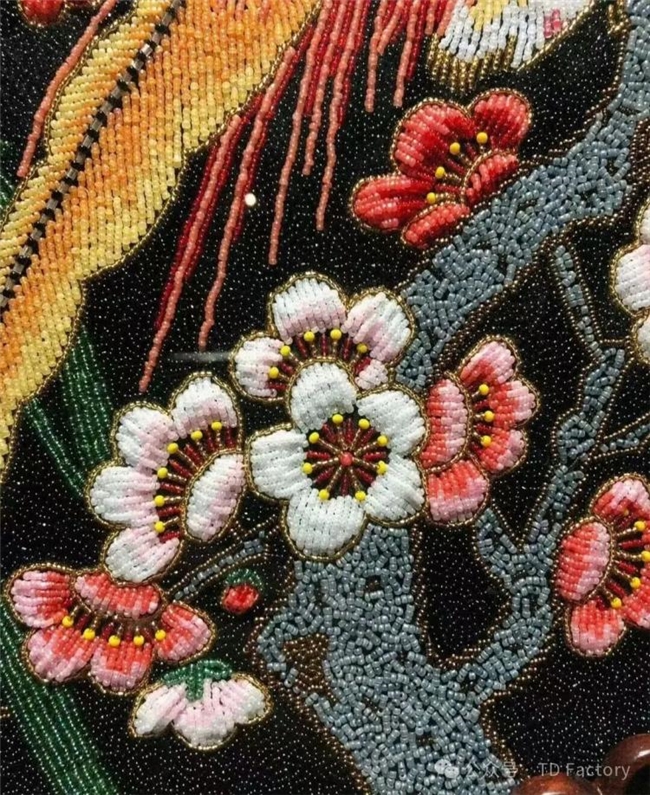
当晨光漫过潮州古城的青石板,百师园珠绣博物馆的展柜里,一粒玻璃珠突然折射出细碎的光芒。这光芒穿越东汉墓葬的幽暗、隋唐戏台的灯火、明清绣房的烛影,最终落在当代绣娘的指尖——这便是潮州珠绣,一项以珠光为墨、针线为笔,在织物上书写了两千年的非遗技艺。2021年,它以粤绣分支的身份跻身国家级非遗名录,那些曾点缀戏服与嫁妆的珠光,终于在新时代绽放出更辽阔的光彩。
When the morning light spread over the bluestone slabs of the ancient city of Chaozhou, in the display case of the Baishiyuan Beaded Embroidery Museum, a glass bead suddenly refracted light into fragments. This radiance pierces through the darkness of the Eastern Han tombs, the lights of the Sui and Tang stages, and the candlelight of the Ming and Qing embroidery rooms, and finally lands on the fingertips of contemporary embroiderers - this is Chaozhou bead embroidery. This intangible cultural heritage technique has been written on fabrics for two thousand years with the light of pearls as ink and needles and threads as pens. In 2021, it was included in the national Intangible Cultural Heritage list as a branch of Yue embroidery. The pearl lustre that once embellished the costumes and dowries has finally shone with broader brilliance in the new era.
一、历史发展
潮州珠绣的源头,藏在考古发现的碎片里。东汉墓葬中出土的玻璃串珠,表面残留的丝线痕迹,悄悄泄露了早期珠饰与织物结合的秘密。彼时的珠料珍稀,多为贵族配饰,直到隋唐时期,民间艺人才将其引入表演服饰——为让戏台形象更鲜活,艺人们将珠料缀于戏服之上,灯光下流转的珠光瞬间抓住观众目光,这便是珠绣最早的实用形态。
The origin of Chaozhou beaded embroidery is hidden in the fragments discovered through archaeological excavations. The silk thread traces remaining on the surface of the glass beads unearthed from the tombs of the Eastern Han Dynasty have quietly revealed the secret of the early combination of bead decoration and fabric. At that time, bead materials were rare and mostly used as accessories for the nobility. It was not until the Sui and Tang Dynasties that folk artists introduced them into performance costumes. To make the image of the stage more vivid, the artists would attach bead materials to the costumes. The flowing pearl light under the light immediately caught the audience's attention. This was the earliest practical form of bead embroidery.
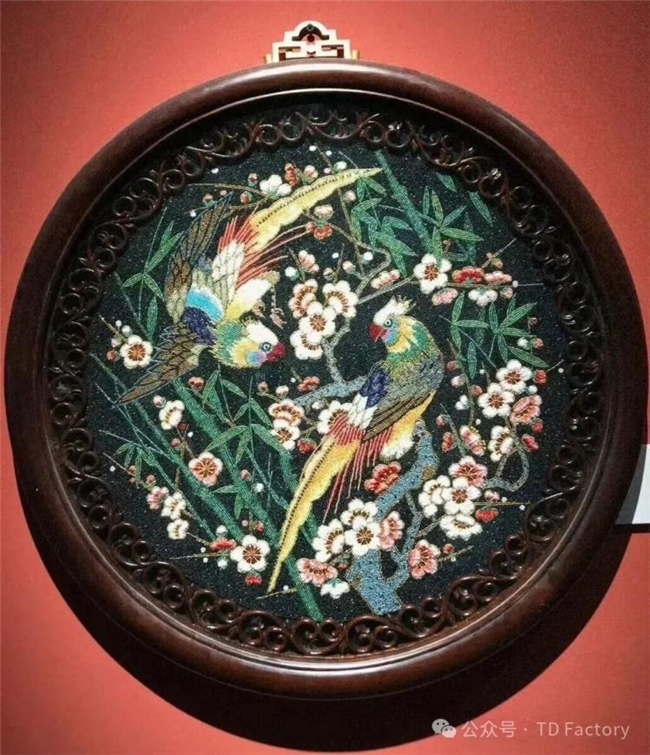
宋元时期是珠绣的成熟期。随着海上丝绸之路的兴盛,潮州作为重要港口,迎来了更丰富的珠料资源,水晶、玛瑙与本地琉璃珠在绣娘们手中交融。皇家贵族对珠绣的青睐,让这项技艺从民间戏台走进深宅大院,绣制题材也从简单纹样扩展到花鸟瑞兽,构图日渐繁复,针法愈发精细。
The Song and Yuan dynasties were the mature period of beaded embroidery. With the prosperity of the Maritime Silk Road, Chaozhou, as an important port, welcomed more abundant pearl resources. Crystals, agates and local glass beads were integrated in the hands of embroiderers. The favour of the royal and noble families for beaded embroidery led this art form to spread from folk stages to deep mansions and large courtyards. The subjects of embroidery also expanded from simple patterns to flowers, birds and auspicious beasts, with increasingly complex compositions and more refined stitches.
陈耿之在文化沙龙中曾精准概括其发展脉络:“起源于汉晋,发展于隋唐,成熟于宋元,鼎盛于明清”,每一个阶段都深深烙印着时代的审美印记。
Chen Gengzhi once precisely summarised its development trajectory in a cultural salon: "It originated in the Han and Jin Dynasties, developed in the Sui and Tang Dynasties, matured in the Song and Yuan Dynasties, and reached its peak in the Ming and Qing Dynasties." Each stage was deeply imprinted with the aesthetic imprints of The Times.
明清时期的潮州,“家家摆绣框,户户有绣娘”成为常态。珠绣不再局限于服饰,从新娘的珠花头饰、陪嫁的珠绣屏风,到日常使用的珠绣荷包、烟袋,渗透到生活的每个角落。这一时期的珠绣形成了鲜明的地域特色。
During the Ming and Qing dynasties in Chaozhou, it became common for every household to have embroidery frames and embroiderers. Beaded embroidery is no longer confined to clothing. It has permeated every corner of life, from the bride's beaded headwear and the beaded screen used as a dowry to the daily use of beaded sachets and tobacco bags. The beaded embroidery of this period developed distinct regional characteristics.
潮汕人崇尚的“好意头”融入纹样,牡丹象征富贵、仙鹤寓意长寿,几何纹与花卉纹对称排布,既符合传统审美,又暗含对生活的期许。更值得称道的是,潮绣艺人突破珍珠成本限制,发明了胶片珠片,既保留珠光效果又降低门槛,为珠绣的普及埋下伏笔。
The "good omen" that the people of Chaoshan Revere is integrated into the patterns. The peony symbolises wealth and honour, and the crane implies longevity. The geometric and floral patterns are symmetrically arranged, which not only conforms to traditional aesthetics but also implies expectations for life. What is even more commendable is that Chaozhou embroidery artists have broken through the cost limit of pearls and invented film beads, which not only retain the pearlescent effect but also lower the threshold, laying the groundwork for the popularisation of bead embroidery.
T&D Factory
传统非遗
潮州珠绣
二、制作工艺:匠心独运的艺术
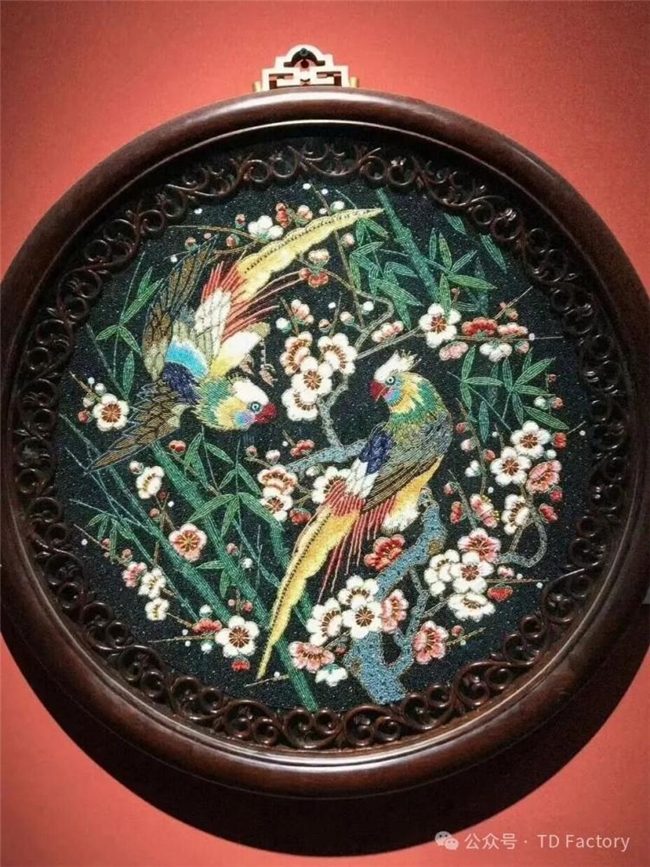
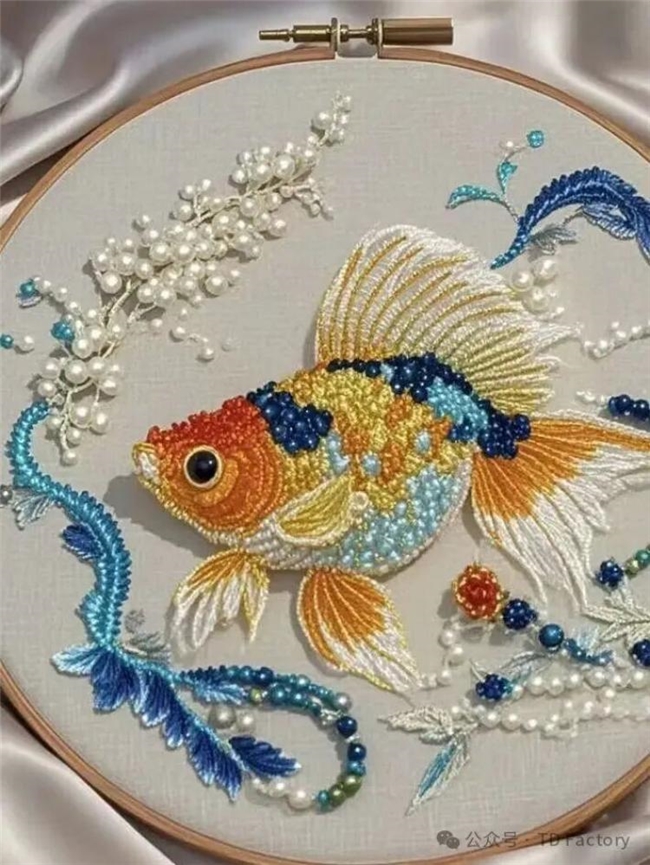

珠绣的独特之处,在于它跳出了传统刺绣“以线代色”的框架,转而“以珠塑形”,其制作流程环环相扣,每一步都凝聚着匠人的心血与智慧。构思阶段是创作的基石,绣者需结合题材意境与珠料特性构思整体效果.
The porcelain clay used to make plum blossom dot colour cups needs to undergo a special treatment of "three sedimentation and three filtration". The kaolin from Jingdezhen is renowned for its high alumina content, which endows the green bodies with excellent plasticity. The red loam soil with high iron content in Jianyang, Fujian Province, provides a unique colouring basis for black glazed cups. These natural raw materials, after undergoing processes such as pounding, rinsing and sedimentation to remove impurities, form fine clay materials, just like raw jade waiting to be carved.
无论是复刻古画神韵还是创作现代纹样,都要提前规划珠光的明暗层次与排布逻辑。随后进入画稿环节,这不仅是艺术创作,更需兼顾工艺可行性,黄伟雄创作《百鹤图》时,便反复调整鹤的姿态比例,确保珠绣呈现时的立体张力。
The stitch draft serves as a bridge connecting design and practical operation. The embroiderer uses specially made drawing needles to outline the patterns on the fabric, marking the size of the beads, colour zones and variations in stitching techniques. Even the arrangement of the beads on each petal is clearly visible. The arrangement of materials is undoubtedly the most patient part. Since bead materials cannot be mixed with colours like pigments, embroiderers need to precisely select from thousands of types of bead materials. Just for the "Hundred Cranes Painting", nearly a thousand materials are used. The gradual change of crane feathers requires the matching of more than ten colour series of beads, and the lustre and size of each bead must perfectly match the adjacent bead materials.
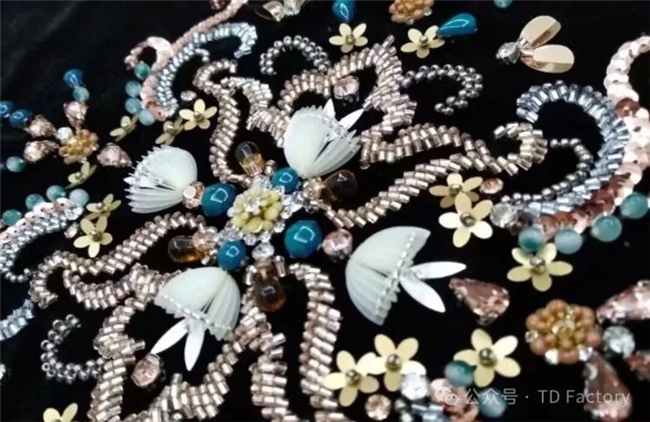
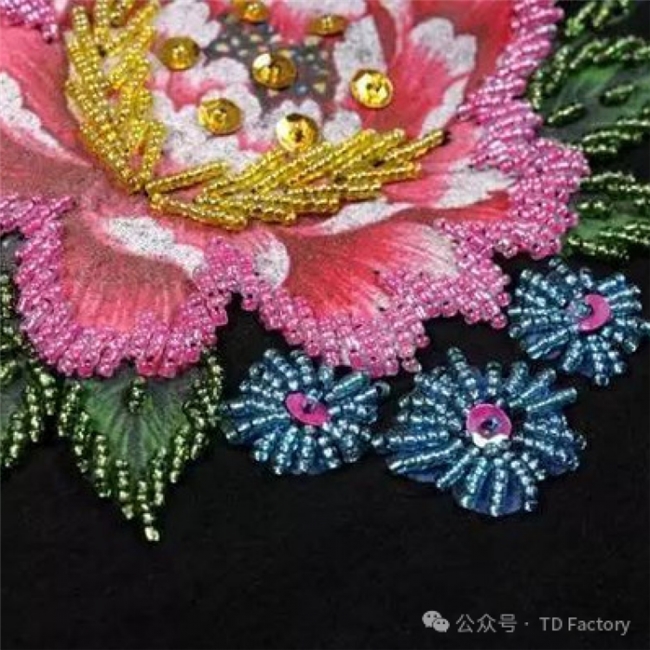
刺绣环节则是技艺的集中展现,绣者需根据纹样需求灵活运用针法,散点绣表现花瓣层次时,珠粒疏密错落需拿捏精准;吊片绣调节丝线长度时,要确保珠片垂坠角度统一。穿珠时力度需均匀,过松易脱落,过紧会破坏织物质感。
The embroidery section is a concentrated display of skills. The embroiderer needs to flexibly apply the needle technique according to the requirements of the pattern. When performing scattered dot embroidery to show the layers of petals, the density of the beads must be precisely controlled. When adjusting the length of the silk thread in the pendant embroidery, it is necessary to ensure that the hanging Angle of the sequins is uniform. When threading beads, the force should be even. If it is too loose, they may fall off; if it is too tight, it will damage the texture of the fabric.
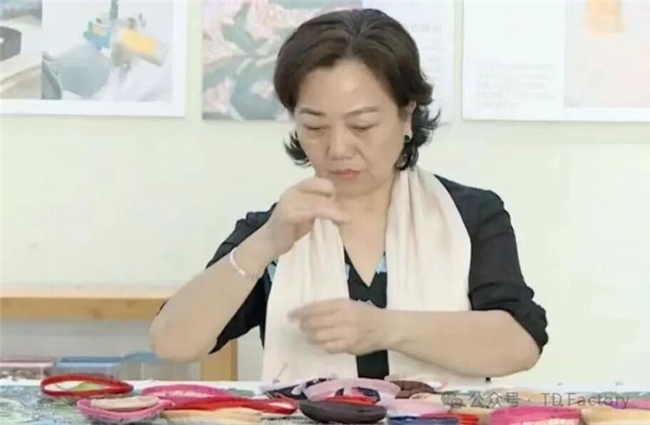
每颗珠的固定角度都影响最终光影效果。从构思到成品,一套复杂珠绣作品往往需数月甚至数年,正是这严谨细致的流程,才让每一件珠绣都成为珠光流转的艺术品。
The fixed Angle of each bead affects the final light and shadow effect. From conception to the final product, a complex set of beaded embroidery often takes months or even years. It is precisely this meticulous and rigorous process that makes each piece of beaded embroidery a work of art with a flowing lustre.
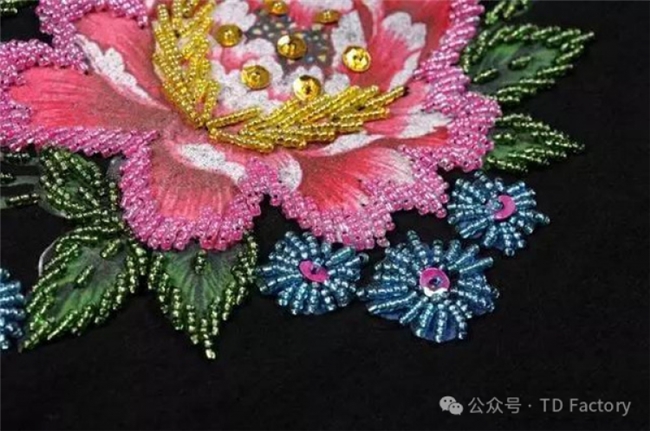
针法是珠绣的灵魂。在潮州珠绣的技艺体系中,收录了超过100种针法,其中散点、乱底、吊片、吊穗等为独有技法。散点针法常用于表现花瓣层次,珠粒疏密错落,模拟花朵盛放的自然形态;吊片针法则通过丝线长度调节珠片垂坠角度,风吹过时,珠片轻摇如波光粼粼。
The stitch technique is the soul of beaded embroidery. In the technical system of Chaozhou bead embroidery, over 100 stitches are included, among which scattered dots, random bases, hanging pieces and hanging tassels are unique techniques. The scattered needle technique is often used to depict the layers of petals and the staggered density of beads, simulating the natural form of blooming flowers. The pendant needle rule adjusts the Angle at which the beads hang by the length of the silk thread. When the wind blows, the beads sway gently like rippling water.
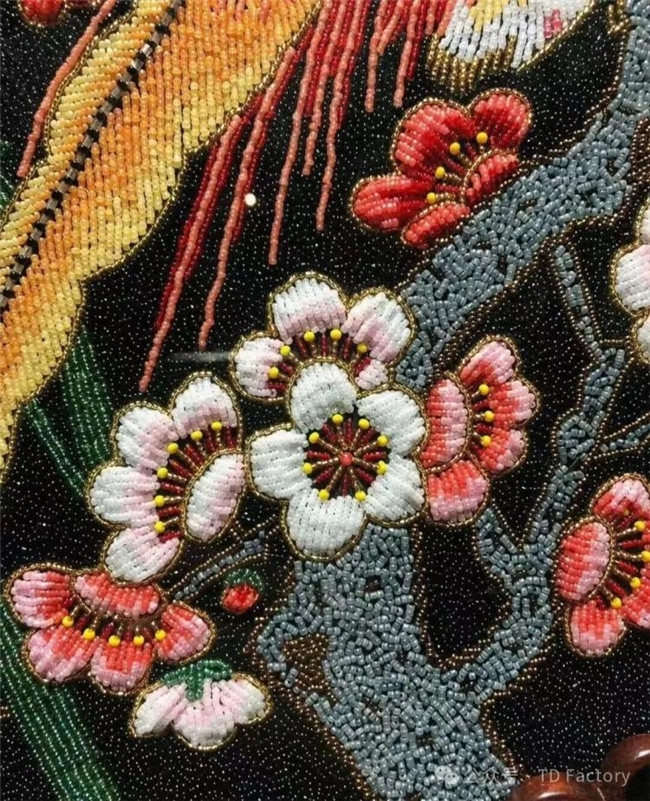
而乱底针法最见功力,看似随意的珠粒排布,实则遵循色彩规律,能呈现出国画晕染般的渐变效果。刘文大师曾评价:“珠绣将光学、色彩学与刺绣工艺完美融合,这是其他绣种难以替代的优势。”
The most skilful technique is the random arrangement of the beads. In fact, it follows the rules of colour and can present a gradient effect similar to the shading effect in traditional Chinese painting. Master Liu Wen once commented: "Beaded embroidery perfectly integrates optics, colour theory and embroidery techniques, which is an irreplaceable advantage for other types of embroidery."
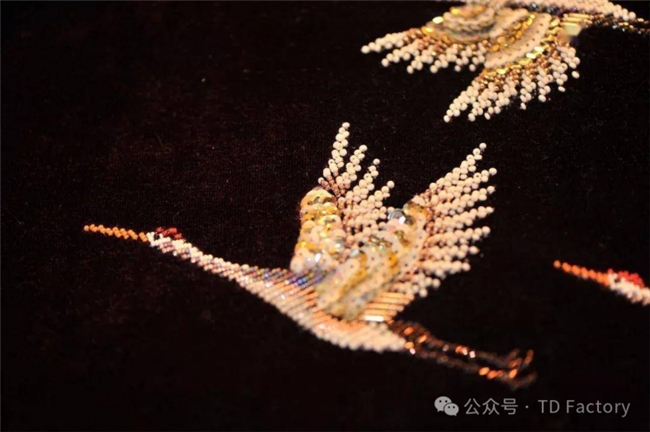
珠绣的艺术魅力在大幅作品中尤为凸显。黄伟雄的代表作《百鹤图珠绣十二屏风》,展开长度达12米,百只仙鹤姿态各异,或引吭高歌,或展翅欲飞。为表现仙鹤羽翼的通透感,他采用半珠绣技法,在绢布底色上局部缀珠,光影下珠粒与绢布虚实相生,既有国画的写意韵味,又有西洋画的立体质感。这幅耗时三年的作品,如今收藏于广东省非遗馆,成为潮州珠绣艺术价值的最佳见证。
The artistic charm of beaded embroidery is particularly prominent in large-scale works. Huang Weixiong's representative work, "Twelve Beaded Screens of a Hundred Cranes", stretches for 12 meters when unfolded. A hundred cranes are in various postures, some singing loudly and others spreading their wings as if about to take flight. To express the transparency of the crane's wings, he adopted the semi-beaded embroidery technique, locally inlaying beads on the silk base colour. Under the play of light and shadow, the beads and the silk create a combination of reality and illusion, which not only has the freehand charm of traditional Chinese painting but also the three-dimensional texture of Western painting. This work, which took three years to complete, is now housed in the Guangdong Provincial Intangible Cultural Heritage Museum and serves as the best testament to the artistic value of Chaozhou beaded embroidery.
潮州珠绣
潮州珠绣
Traditionalintangible
cultural heritage
非遗传统
三、珠心:守艺人的薪火与突围
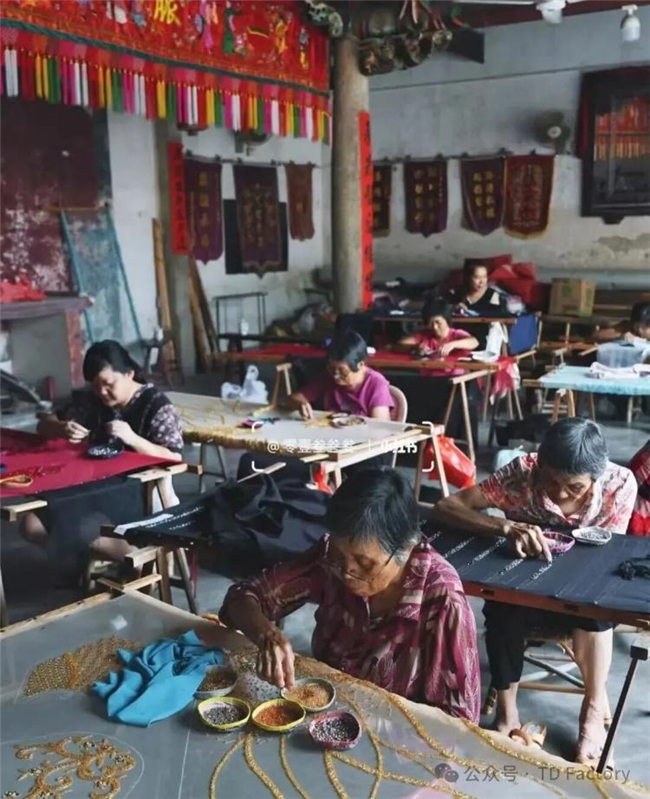
黄伟雄的珠绣人生,是潮州珠绣传承的缩影。6岁时,他在绣花社的“花规”旁看奶奶和母亲刺绣,绣一对枕头花赚2块钱的记忆,让他对针线产生了天然亲近。母亲手把手教他穿针引线,而他则偷偷描摹前辈设计的花稿,一沓沓画纸为日后的创作埋下种子。
Huang Weixiong's life in beaded embroidery is a microcosm of the inheritance of Chaozhou beaded embroidery. When he was six years old, the memory of watching his grandmother and mother embroider beside the "flower compass" in the embroidery shop and earning two yuan by embroidering a pair of pillow flowers made him naturally close to needles and threads. His mother taught him how to thread a needle hand in hand, while he secretly copied the flower patterns designed by his predecessors. Stacks of drawing paper sowed the seeds for his future creations.
高中毕业后,他系统学习服装设计与刺绣图案,从国营潮绣厂的技术员到二轻工业研究所的设计师,再到1993年创办自己的公司,四十余年与珠绣相伴,指尖磨出的薄茧,是他最珍贵的勋章。
After graduating from high school, he systematically studied fashion design and embroidery patterns. From a technician in a state-owned Chaoxiu factory to a designer at the Second Light Industry Research Institute, and then he founded his own company in 1993, he has been accompanied by beaded embroidery for over four decades. The thin cocoons worn on his fingertips are his most precious MEDALS.
上世纪90年代,潮州珠绣迎来产业高峰。依托珠绣工艺的婚纱礼服产业蓬勃发展,高峰时期企业超过1600家,年产礼服超2000万件,远销二十多个国家和地区。但繁荣背后危机暗藏:工业化生产冲击下,手工珠绣的工价优势不再,年轻一代更倾向选择流水线工作,珠绣人才出现断层。“车间里都是大龄绣娘,年轻人很少愿意来”,珠绣外发人员许湘玲的话,道出了许多传承人的焦虑。
In the 1990s, Chaozhou beaded embroidery witnessed a peak in its industry. The wedding dress and formal wear industry, relying on the beadwork embroidery technique, has been booming. At its peak, there were over 1,600 enterprises, with an annual output of more than 20 million formal wear pieces, which were exported to over 20 countries and regions. However, behind the prosperity lies a hidden crisis: Under the impact of industrialised production, the price advantage of handcrafted beaded embroidery is no longer there, and the younger generation is more inclined to choose assembly line work, resulting in a shortage of beaded embroidery talents. "Most of the embroiderers in the workshop are of advanced age, and few young people are willing to come," said Xu Xiangling, an external distributor of beaded embroidery, revealing the anxiety of many inheritors.
黄伟雄选择用创新打破困局。2004年,他开创性地将珠绣与绘画结合,推出“珠绣画”这一新品类,将实用工艺提升至纯艺术层面,并成功申请专利。这一突破让珠绣摆脱了“装饰附属”的定位,成为独立艺术品。
Wong Wai-hung chose to break the deadlock through innovation. In 2004, he innovatively combined beaded embroidery with painting, launching a new category called "beaded embroidery Painting", elevating practical craftsmanship to a pure artistic level and successfully applying for a patent. This breakthrough has enabled beaded embroidery to break away from its status as a "decorative accessory" and become an independent work of art.
为让技艺传承下去,2014年起,他在广东女子学院设立大师工作室,开设专业课程,七年培养500余名学生;2015年创办百师园,四楼的珠绣博物馆通过实物、图片与文字,系统梳理珠绣历史,开设研学课程,每年接待超10万人次参观,其半数以上是学生。
To ensure the continuation of his skills, since 2014, he has set up a master's studio at Guangdong Women's University, offering professional courses and training to over 500 students in seven years. In 2015, Bai Shi Yuan was founded. The Beadwork Museum on the fourth floor systematically sorts out the history of beadwork through physical objects, pictures and texts. It also offers study Tours and receives over 100,000 visitors each year, more than half of whom are students.
四、珠途:传统工艺的现代新生
在2024年的广州国际时尚周上,一组以潮州珠绣为核心元素的礼服惊艳亮相。设计师将传统“过桥针法”绣制的凤凰纹样,与简约西式剪裁结合,幻彩珠片在T台上流转,既有东方古典韵味,又符合现代审美。这场景印证了蔡照波的判断:“珠绣向上可奢华、向下可亲民,只要找对路径,就能在当代市场站稳脚跟。”
At the 2024 Guangzhou International Fashion Week, a set of evening gowns with Chaozhou beaded embroidery as the core element made a stunning appearance. The designer combined the phoenix pattern embroidered with the traditional "bridge stitch" technique with simple Western-style cutting. The iridescent sequins flowed on the catwalk, exuding both the classical charm of the East and modern aesthetics. This scene confirmed CAI Zhaobo's judgment: "Beaded embroidery can be luxurious at the top and approachable at the bottom. As long as the right path is found, it can gain a firm foothold in the contemporary market."
产业化与精品化并行,是潮州珠绣的发展方向。黄伟雄的企业形成了清晰的产品矩阵:高端珠绣画定位艺术品收藏市场,动辄数十万的价格彰显其工艺价值;中端的珠绣屏风、装饰画满足家居需求;而珠绣书签、茶杯垫等文创产品,价格从几元到几百元不等,成为大众消费得起的非遗周边。这种“金字塔式”布局,既保证了技艺传承的精度,又扩大了市场覆盖面,让珠绣产业形成良性循环。
Industrialisation and refinement go hand in hand, which is the development direction of Chaozhou bead embroidery. Huang Weixiong's enterprise has formed a clear product matrix: high-end beaded embroidery paintings are positioned in the art collection market, with prices often reaching hundreds of thousands of yuan, highlighting their craftsmanship value. Mid-range beaded embroidery screens and decorative paintings meet the needs of home decoration. Beaded embroidery bookmarks, coasters and other cultural and creative products, with prices ranging from a few yuan to several hundred yuan, have become affordable intangible cultural heritage merchandise for the general public. This "pyramid-shaped" layout not only ensures the precision of craftsmanship inheritance but also expands the market coverage, enabling the beaded embroidery industry to form a virtuous cycle.
Traditional intangible cultural heritage
<<<
Chaozhou bead embroidery
「潮州珠绣」
/传承文化经典
四、当代传承与创新
数字化为珠绣传承注入新活力。百师园正计划引入多媒体展陈技术,通过VR技术还原珠绣制作过程,让观众在虚拟空间中体验穿针缀珠的乐趣;线上课程的推出,打破了地域限制,远在北方的学生也能跟着传承人学习基础针法。
Digitalisation has injected new vitality into the inheritance of beaded embroidery. Baishi Garden is planning to introduce multimedia exhibition technology, using VR technology to recreate the process of beaded embroidery production, allowing visitors to experience the joy of threading needles and attaching beads in a virtual space. The launch of online courses has broken through geographical restrictions. Students in the far north can also learn basic acupuncture techniques from inheritors.
新媒体传播更让珠绣“出圈”,大师创作日常、珠绣技艺小科普等短视频在平台传播,单条视频播放量常破百万,让“潮州珠绣”成为热搜关键词。
New media dissemination has further made beading embroidery "go viral". Short videos such as the daily creations of masters and small science popularisation of beading embroidery techniques have been spread on platforms, with each video often receiving over a million views, making "Chaozhou beading embroidery" a hot search keyword.
文化融合则为珠绣打开了更广阔的天地。作为海上丝绸之路的文化载体,潮州珠绣正成为中外交流的使者——在“一带一路”文化展上,珠绣作品被赠予外国使节;在海外孔子学院,珠绣体验课成为传播中国文化的重要课程。而“珠绣+文旅”“珠绣+研学”的模式,让游客在潮州不仅能欣赏珠绣精品,还能亲手制作珠绣小件,这种沉浸式体验让非遗传承更具生命力。
Cultural integration has opened up a broader world for beaded embroidery. As a cultural carrier of the Maritime Silk Road, Chaozhou beaded embroidery is becoming an envoy of exchanges between China and foreign countries. At the "Belt and Road" Cultural Exhibition, beaded embroidery works were presented to foreign envoys. At Confucius Institutes overseas, the beaded embroidery experience class has become an important course for spreading Chinese culture. The model of "beaded embroidery + cultural tourism" and "beaded embroidery + study Tours" enables tourists in Chaozhou not only to appreciate beaded embroidery masterpieces but also to make small beaded embroidery pieces by hand. This immersive experience makes the inheritance of intangible cultural heritage more vibrant.
当一粒珠子被绣入织物,它便不再是普通的材料,而是承载着历史、技艺与情感的文化符号。在守艺人与创新者的共同努力下,这抹珠光必将穿越更多岁月,在新时代的织物上,绣出更璀璨的未来。
When a bead is embroidered onto fabric, it is no longer an ordinary material but a cultural symbol carrying history, craftsmanship and emotion. With the joint efforts of the artisans and innovators, this glimmer of pearl will surely traverse more years and embroider a brighter future on the fabric of the new era.